As of 2025, please go to stuff.davidaugust.com, my newer blog. See you there!

Showing posts with label connecting. Show all posts

Thursday, November 8, 2012

Talking Head Videos Bore Audiences Online

Boring an audience is almost the only thing that is never a good idea to do in a video. Probably not a good idea in any form of entertainment or media. But nonetheless, people continue to make talking head videos, because they are often easy and cheap.

Alas, this may never change, and perhaps shouldn't change since keeping costs down and productions fast is just about as important as not boring the audience. But it is worth knowing the realities even if you're committed to making a talking head video:

The eyetracking data clearly show that a talking head is boring, even for 24 seconds. On the Web, 24 seconds is a long time - too long for users to keep their attention on something monotonous

(from Talking-Head Video Is Boring Online).

Monday, October 29, 2012

Privacy Evolves

Zach Cumer posted about Safety & Security for the now + the future and graciously invited me to comment. Here is what I wrote today:

Thank you for the invite to comment. I'm out and about right now, so here are some brief thoughts.

The Internet, social media and our digital devices have brought transparency to our lives and the organizations we interact with. That never quite existed like this before. The youngest generation's entire idea of privacy is different than older generations' tend to be.

This new transparency is a double edged sword. On the one hand information is more available and often more useful than ever before. On the other, what used to be physical things, the artifacts of our lives, have become increasingly digital. Not everyone is ready for or understands what this means, even though it has already happened in many ways.

Hurricane Sandy, the storm that is hitting the East Coast of the US right now, illustrates: the moment the Internet goes out, our lives are plunged into 1980 style existence. Anything online, "in the cloud," is suddenly unavailable. Even more, if power goes out too, much of our lives goes back to 1880. Once the batteries run out, we learn the hard way what not being ready for power outages, being "1880 compliant" as I call it, is. We aren't used to how to do things like they were done in 1880. At least not long term.

At a retail job I had just after high school, the store couldn't see what was in inventory, on its own shelves, if there was a storm. The storm made the satellite link to headquarters go down. And the store's local computers didn't have that information by themselves. Technically, this is a problem of not having business continuity in the event of natural disaster, or simple rainfall in their case. Today, millions of people and companies can't get to their own address books, music collections or email because of a storm. One hopes the data-centers that store our digital lives don't lose the data in the rain and wind. Once hopes we'll still be able to get to everything after the storm has past. We need life continuity whether our tech works or not.

But, back to the privacy issues your post brings up. We don't send postal mail in clear envelopes because everyone wants, even needs, some privacy in their lives. Privacy still matters, and many call personal privacy a basic human right. Chapter 2 article 7 of the Charter of Fundamental Rights of the European Union says [e]veryone has the right to respect for his or her private and family life, home and communications. Yet despite privacy still going into laws, we don't have great answers for how our lives and our whole society are affected when privacy erodes accidentally, or through malicious breaches. Or simply because the privacy settings can be confusing.

From the scary sounding scenario of showing up online in the background of a stranger's photo auto-tagged by facial recognition, to the more likely possibility that you forget your smartphone at a bar, with your identity and financial data on it, we as a society are forced to rethink things. Beyond extremes like home break-ins because the people check in publicly online, or identity theft, there are other ways our privacy is dynamic. Web search histories and online profiles together are used to market things to us based on what we share with the world. What we share is both things we know about, like a restaurant review we know we wrote and share in public, and stuff we don't know about, like data from Google on flu searches getting used by the Centers for Disease Control to predict outbreaks more accurately. What do we want to have private and what can never be private again not matter how much we want it to be? As a civilization we lack great answers.

I have some ideas how to prepare ourselves. Computers are not just laptops and desktops, they are phones and tablets and gaming consoles and more. Computers and networks are designed to store and transmit information. From the rubber feet on the bottom, to the casing, to every line of code, everything about them is for keeping and sharing information; it is their fundamental purpose. Anything done to contain or remove information from computers and networks works against their foundation, their purpose. And that is why all ways to try to keep information private is going against the grain of computers. In a perfect world, a secret we want to have stay secret should never be digital. Once it is, the uphill battle of keeping it private begins.

There is almost no way to remember that things tend toward being stored and shared digitally. Even harder to live knowing this moment to moment. Our devices get so tangled up in our day to day lives, it's easy to be lulled into comfort. It is easy to ignore that our devices easily share anything and everything we put on them, and reveal everything we interact with. So try to brace yourself, if such a thing is possible. Brace yourself for having something of yours shared when you don't want it to be. This very possibly can happen to you and to me. We may want to prepare for what we do when our privacy goes away. This isn't actually a new thing. Secrets have become not secret for eons. Not always, but often.

Forever, bad things have sometimes happened to good people. Having your private stuff go public is just one way it can happen. Panic and fear are never a good answer. Be aware of what your devices and digital life might reveal of your life, thoughts and such. Be aware no one can be perfect in securing stuff. And beyond matters of life and death, like national security, try to be open. When you are open you get to be involved in how the world gets your private stuff. And for god's sake, don't use "password" or your name or someone's birth-date as your access code/pin/password.

Like having locks on doors, if you don't use the security things you have, then you don't get the security they can give. Put a passcode on your smartphone. That way if your phone is lost or stolen, your email, profiles and the information about all your contacts is less likely to be in the open. If you're worried dirty pictures or video you would take might end up on tv or something, don't take them. And breathe. Whether we like technology or not, it is not our enemy. And whether we want technology to be part of our lives or not, it isn't going away anytime soon.

Society can't really ever move beyond itself. As our sense of privacy evolves, there will be growing pains. And there's nothing horribly wrong with still using cash, or still getting a paper statement like it's 1880.

Tuesday, October 16, 2012

Election Year Bigotry

So many online seem to genuinely not understand how any decent person could not be on their side of politics, no matter which side they themselves are on. This is bigotry, make no mistake, bigotry. It is as destructive as all other forms of bigotry. It is the biggest obstacle we as a nation face.

We are all Americans, and smart, good people disagree with you. You may be smart and good intentioned, they may be smart and good intentioned, and you may disagree fundamentally just the same. That is exactly how it should be so please open your mind to the reality of living with people who don't share your exact beliefs.

Or admit your bigotry by starting all comments on politics like "I can't believe the race is this close" or "how can he believe what he just said" with the phrase "I'm an ignorant bigot who would rather bicker than do anything good for anyone on earth ever, but..." and then continue your meaningless diatribe.

Then I could at least respect your candor, honesty and self-awareness while I cringe at your closed-minded destructive us-them thinking while I'm feeling utterly alone in thinking that our federated republic, the Great American Experiment, may not be perfect, but it is so far the best way for humans to organize together for advancement of our individual and collective goals.

And what ever the case, while I may find such bigotry wasteful, senseless, short sighted and not even in anyone's self interest, I fervently defend your right to say it, and cherish that my countrymen and women have such varied beliefs and ideas. E pluribus unum, out of many one.

Tuesday, June 12, 2012

Everything is Global

You have to remember that in the age of Twitter and YouTube, nothing is a local event anymore. Every event is global, or can be global, within seconds

Aral Balkan writing about Microsoft's recent gaff in Norway (from The story behind that nasty Microsoft dance routine).

Thursday, March 29, 2012

Film Streaming Will Beat Films on Disc this Year

Online streaming viewing of films will outpace disc viewing this year for the first time. This isn't too surprising given the tendency for the audience to want to watch what they want, where and when they want and their increasing expectations that they will be able to do so more and more.

Thursday, March 15, 2012

Show the Audience Your Process

Find what it is about your business that makes you unique, whether its artistry, creativity, or service. And then find a way to bring the video camera into that process. More often than you think, people actually do want to see how the sausage is made

(from ReelSEO).

Wednesday, March 14, 2012

Mobile Devices Overtaking PCs for Accessing Web

With current growth rates, web access by people on the move - via laptops and smart mobile devices - is likely to exceed web access from desktop computers within the next five years.

From an International Telecommunication Union press release from June 2010. There are some that say ...in the next 18–24 months, mobile devices will overtake PCs as the most popular way to access the web and vitally point out the need to stop treating the mobile web as a separate thing.

Thursday, March 8, 2012

Business Model for New Media

The discussion of business models to provide for sustainability is not particularly new for new media. However, some patterns have emerged (yet there is no one solution to the challenge. Dilettante Douchebag sums things up like this:

  1. Make something with your resources as they exist now. Start off small, even if it's one five minute episode.
  2. Put it out on any distribution channel you have available to you. Your website, social media, YouTube, or one of the thousand independent film streaming services.
  3. Determine how it was received and how you can better capture you audience's love next time.
  4. Repeat one through four for a bit before moving on to step 5. If you have enough content, you may now repackage it into a pilot, a feature, whatever your heart desires.
  5. If you cannot develop a fan base, start over on step one with a new product. Or quit and become an organic mushroom farmer in Carnation. If you have developed a fan base, move on to step 7.
  6. Give the fans an opportunity to show their love for your product based on what you have already done. You may use Kickstarter if you would like. If they show the love, move on to step 8.
  7. Create more of what your fans love, except better. Because of your fan’s support you will have a larger budget.
  8. Repeat step 7.
  9. Create a new product that will appeal to your existing fan base and bring them along for the journey. Start at step 1.

Thursday, February 2, 2012

Push a Whole Season Live at Once

As I have suggested to many a web TV producer when discussing video release timing, no reason to fight to get people back for subsequent episodes if you already have an entire seaosn shot. Show them all at once:

As Netflix debuts its first original series, "Lilyhammer," on Feb. 6, the video subscription service has settled on a scheduling strategy suited for the digital world: making every episode available at once.
Signaling that it's embracing users' preference to watch multiple episodes of their favorite programs as a "marathon," Netflix won't be spacing out the eight shows of its first season of the comedic crime series over several weeks.
If you love the first episode, there is no need to wait until next week, or to set a DVR, to catch the next one, Netflix's chief content officer, Ted Sarandos, said in a statement Tuesday

(from Los Angeles Times).

Thursday, January 12, 2012

Brands Come from Actions Not Words

BP - pollution.
Enron - stolen money.
Firestone Tires - car crashes.

Possible associations. All 3 mean something to their customers and prospects that is not what the companies would chose for it to mean. The brand is in the customers' mind. It is influenced by the company's activities even more than messaging. Who someone or something is, regardless of intention, is what brand is.

Any person, or group of people (a company) that disappoints you through their actions will never fully win back your trust through marketing messages. The soul of a company, the filter through which their decisions and actions are made, is the closest to the brand the company itself will ever get, and those decisions and actions are as close to branding as they can come.

Marketing messages are ideally a reflection of a company's soul. If the heart of the company is sick, then the best marketing messages can do is confuse and conceal it. A company that hurts people for instance, can only try to distract from this reality through marketing; being who you say you are is required, especially in the age of the internet. If a company's heart is healthy, and the marketing doesn't reflect that, then the marketing is broken. The impression the customers and prospects have of a company is "the brand" out in the world. This may differ significantly from what the company intends. Truth can be changed, but truth is truth whether or not we want it to be.

Saturday, January 7, 2012

Core Users and Threshold Paywalls

There has never been a mass market for good journalism in this country. What there used to be was a mass market for print ads, coupled with a mass market for a physical bundle of entertainment, opinion, and information; these were tied to an institutional agreement to subsidize a modicum of real journalism. In that mass market, the opinions of the politically engaged readers didn’t matter much, outnumbered as they were by people checking their horoscopes. This suited advertisers fine; they have always preferred a centrist and distanced political outlook, the better not to alienate potential customers. When the politically engaged readers are also the only paying readers, however, their opinion will come to matter more, and in ways that will sometimes contradict the advertisers’ desires for anodyne coverage

(from Clay Shirky).

Friday, January 6, 2012

Don't Advertise

For years Google didn't run any ads on TV, in magazines, radio or anywhere. Probably for at least the first 5 years of their existence. This was a deliberate choice. They knew that their search engine was getting better and better. Tomorrow it would be better than it is today, and next week even better than tomorrow.

So since the first time someone used the search engine would set that person's first impression, they reasoned that it was better for someone to use it for the first time in the future than it was today. Better to have them not come today, but come tomorrow. Even better for a first time user to come next week than tomorrow. So the further in the future you came to use them for the first time, the more you would like it.

Advertising, asking people to come today, would lead people to have a not-as-good expeirence their first time. So, they didn't advertise and counted on, preferred, that people come later, when they were better, more ready for the audience.

Many things improve with time, get better with each iteration. If something you are doing is such a thing, consider not advertising. While getting a crowd to show up on day one might feed the ego, pacify investors or otherwise sound like a good idea, a better idea may be to be glad people haven't come in droves today. Keep working to delight those that may come tomorrow, and the next day, and the next, and so on. No advertising is sometimes the best advertising.

Monday, October 24, 2011

Get Found: Lecture at USC Business School

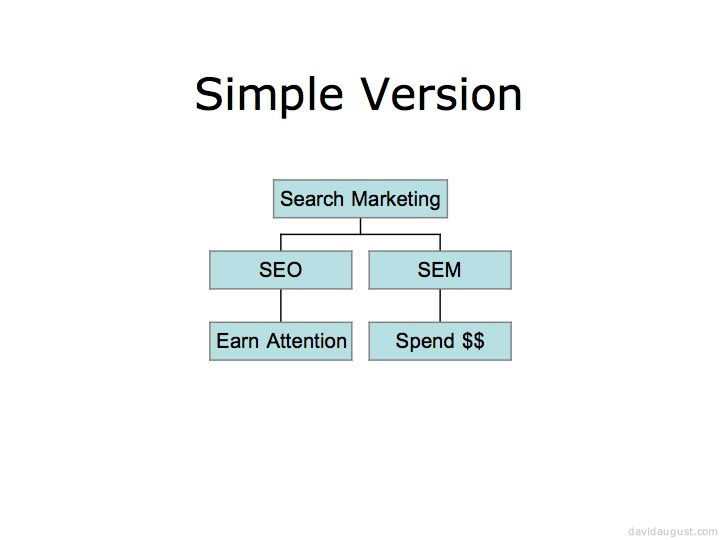
I'm guest lecturing at USC's business school tomorrow. Here's a sneak peak at 2 slides from my lecture "Improve the World → Make Things Findable" (they make more sense in the context of my whole presentation).

3 circle venn diagram of where audiences may be online: Facebook, Twitter, Google+ or elsewhere

a simple diagram showing how SEO is earned attention and SEM is money spent

Sites I Cite:
http://davaug.com/befast
http://davaug.com/uptimematters
http://davaug.com/deadpagerank
http://davaug.com/write4search
http://davaug.com/filterbub

Tuesday, June 7, 2011

Beware Filter Bubbles

As web personalize services there's an unintended consequence: We get trapped in a "filter bubble" and don't get exposed to information that could challenge or broaden our worldview.

Friday, May 27, 2011

Hold On

Hold on to what is good even if it is a handful of earth. 
Hold on to what you believe even if it is a tree which stands by itself. 
Hold on to what you must do even if it is a long way from here. 
Hold on to life even when it is easier letting go. 
Hold on to my hand even when I have gone away from you.

-Pueblo Blessing

Tuesday, April 12, 2011

SIGNS

Sometimes a dreary existence needs Signs.

Thursday, March 24, 2011

How Not to Make Friends and Supporters

Them: "Could you mention my company on your blog?"
Me: "I don't think so...at least not yet"

They leave a spam comment, which never sees the light of day because comments are moderated.

Me: "Uh, why did you try to leave a spam comment?"
Them: "Oh, we hired an SEO firm and I didn't even know they did that. I'll tell them to stay away from your blog from now on."
Me: "..."

I'm not sure they "get it" that spam is not a good idea. Ever. I also am not sure their cash flow is positive. Not a coincidence. The invisible hand is about to slap them.

Sunday, March 13, 2011

First Words

Sort of like babies, how we communicate has had its first words:

Telegraph, May 24, 1844
What hath God wrought? - Samuel Morse, from the King James version of Numbers 23:23, sent from the Supreme Court chamber in the Capitol in Washington, DC, to the B & O Railroad Depot in Baltimore, Maryland.
image of first telegraph message

Telephone, March 10, 1876
Mr. Watson - come here - I want to see you. - Alexander Graham Bell to his assistant. The first sound he sent was on June 2, 1875 of a twanging clock spring, and was when he sort of discovered sound could be sent electronically.
page from Alexander Graham Bell's journal with notes about the first phone message transmitted

Radio, December 23rd, 1900
one, two, three, four, is it snowing where you are Mr. Thiesen? If it is, would you telegraph back to me? - Reginald Aubrey Fessenden on Cobb island in the middle of the Potomac river.

Internet, October 29, 1969 10:30 PM
login - Leonard Kleinrock describes it:
The transmission itself was simply to "login" to SRI from UCLA. We succeeded in transmitting the "l" and the "o" and then the system crashed! Hence, the first message on the Internet was "Lo!". We were able to do the full login about an hour later.
image of page of notes taken about the first internet message

Email, late 1971
QWERTYUIOP - Ray Tomlinson, could have been ASDFGHJK or something else equally test-ish
The first message of any substance was a message announcing the availability of network email. The exact content is unknown, but it gave instructions about using the at sign to separate the user's name from his host computer name.

Text Message, December 1992
Merry Christmas - Neil Papworth, test engineer for Sema Group sent an SMS with a personal computer to the phone of Richard Jarvis via the Vodafone network
I was a young engineer working on new communications technologies. We thought SMS was a clever way for a company's staff to send simple messages to one another. I'd never have predicted that it would spread into the consumer world and become what it is today. At the time it didn't seem like a big deal.

Twitter, March 21, 2006 12:50 PM
just setting up my twttr - Jack Dorsey
screenshot of the first twitter message

Tuesday, April 6, 2010

MBAs Running Showbiz

MBAs running showbiz is like having a doctor hang ceiling tiles: they might get it right, but why would you ask them to try in the first place? To have MBAs, general business people, in charge of entertainment companies makes little sense in the final analysis. Sure they might know about allocating money and saying what stockholders, the board and colleagues want to hear, but they aren't showman (and show-women; show people).

Too many decision makers didn't come here to entertain anyone. The influence, power, money and glamor appeal to many, but few continue on in their motives and aim to change minds and hearts, move people, innovate or change anything but their own position and accolades. Most executives, and those aspiring to be executives, are skilled at one thing truly, and at the exclusion of other interests it's all they do: Most executives just move piles of money around.

Please don't mistake my meaning. Using resources well is vital for most things in life, be it rolling a tube of tooth paste from the bottom, or keeping a multi-billion dollar diversified media and entertainment company from going broke. Capital allocation, putting money toward what it makes sense to put it towards, is good business, and part of 'show business.' But making money is only part of show business. There is so much more that can be done in addition.

Show people, like Walt Disney, Cecil B. DeMille and P.T. Barnum, can make fortunes to be sure, but that's not all they do. In addition to making money, show people's efforts transform or create entire industries/genres/cultures and expand the thoughts/feelings/actions of countless millions of people for multiple generations.

Shakespeare was a very successful business person profiting from his own acting, writing and theatre ownership/management. He owned a stake in the Lord Chamberlain's Men (later named the King's Men), the leading theatre company in London (and therefore England) which built the Globe and owned other very successful theatres. He likely originated (i.e., was the first to play) some of the most re-performed acting roles ever written (by him) and in plays by others. He built a fortune in the late 1500s and early 1600s when if you were born without a lot money, making a lot money was very difficult. But Shakespeare's financial success is a footnote to his accomplishments.

  • affected all of Western Culture
  • transformed and created huge portions of the English language itself
  • touched and touches millions of minds, hearts and dreams
  • created 37 plays and over 150 poems, often considered the most important literary works ever made
  • keeps and has kept thousands of publishers/typesetters/editors/actors/directors/etc. gainfully employed for the last few centuries

And his accomplishments show no signs of slowing down anytime in the foreseeable future. No media company has even tied him, on any one of them. They should try.

To hope to keep a business running and growing is to lack ambition. Being concerned with dominating an industry, or increasing customer 'touch points' (the times and ways a company interacts with customers) and ignoring the need for good quality entertainment, entertainment that the audience so desperately craves, is to call a failed professional life a financial success and then give yourself a congratulatory pat on the back.

Yes, all things must sustain themselves or they are not healthy. A child's lemonade stand ought to make it's money back or (and this may not be a bad thing) it's subsidized playtime. If the child dilutes the lemonade to make the stand financially profitable, have they succeeded? They succeeded at making money while disappointing every customer and learning that cheating can get you loot. Empty, unfeeling, void of true value, loot. Instead, if the child makes the lemonade so tasty people pay a premium for it, then the loot can come in piles and buyers are happier/less thirsty too. Everyone can gain, no one need lose, and the world can become a better place.

Annual financial reports, no matter how large the numbers on them are, will never be able to have the worth of good financial results from the massive creation of value at a Shakespearean level. You say you're no Shakespeare? Good, we already had one of those, but never has there been another you. Make great work. You say that's hard? Yes, it's hard, harder than we can almost imagine; it is very hard to create great work. That's why it is called work and being hard makes it no less worth doing.

By all means make money, and don't ignore the day-to-day need to pay-the-bills. And create value while you make the money.

Tuesday, December 29, 2009

Connection Can't Be Detached

We are all faced with clients that want to know ROI, that don't "get it" and I know that when I'm looking to educate these types of clients, every piece of data and every quote that supports my point of view comes in handy. So, here are the pieces I think will help me, and hopefully you in future decks and meetings:
  • Simply put, digital brand experiences create customers.
  • Our findings lead us to believe that marketers need to be dramatic...and not simply settle for awareness or impressions: engagement = affinity

(from she dorks out). Off the cuff, by the way, and without fully thinking it through I'll say this: "engagement" is often another word for connecting with an audience, and "affinity" is a way to keep at arms length the idea of people liking you (or your brand). In both cases they seem to be accepted ways to gloss the audience's desire for human connection, and intimacy. While I understand the corporate reluctance to embrace things like intimacy, moving people emotionally can't really be done from a distance. Someone must take that risk, and if companies aren't willing to, perhaps they just choose to hire someone who will and hope it will still work.